Sabtu, 10 Desember 2011

Selasa, 06 Desember 2011
Lessons marketers can learn from "why this kolaveri di"
If one looks in deep, this song had all the makings for becoming a viral success. Any digital marketer could learn from the success of WTKD song. Here are some of the recipes that went into making this an success:
Simplicity: A song with least common denominator English words regularly used by the youth with couple of simple vernacular words... the song has the universality of nursery rhymes like, Twinkle, Twinkle Little star.... or a Johnny, Johnny, Yes Papa.. With no music knowledge required, little wonder anybody could hum it completely by listening to it couple of times.
Surprise: Dhanush,is a popular actor in Tamil Nadu... A State known to revere their movie idols. While he is known for his acting and dancing skills... it was a surprise element that made the people check out on his song writing and singing skills. People would have started watching the video curios to see Dhanush in a recording studio, singing the actual song
Similarity: Most of us humans (especially Males) tend to suffer from 'lose-in-love' syndrome. The content (lyrics)is talking about being let down in 'love'. Pain & Healing are wired into any culture. Be it religion, or an individual experience...we all believe that without experiencing the emotions of pain and then the healing we are not complete. The content of the song, strikes the right chord here.
Star-power: While the initial views would have come from people belonging to Tamil Nadu, Dhanush being the son-in-law of a ever more popular Rajnikanth, would have helped in pushing the songs outside the immediate circle of influence. Other than the protagonist, the presence of Rajnikanth's daughter and Shruti Hasan, daughter of Kamal Hasan makes it all the more reason to watch the video
Social power: The social network (especially Facebook & Twitter), has helped popularize this song. Being a trending topic on Twitter and the peer recommendation by sharing the song on their wall posts made it accessible to more and more people who are not familiar with the actors or the region
Support: It was infact the traditional media that gave the song the fillip. Getting on the radar of Television (first MTV and then even the News channels) had raised the awareness of the song so much that more and more people got to know about the song and hence a reason to view the same online
Seeding: Last, if not the least, the spin doctors at Sony Music had made a conscious effort to seed the song. Be it the traditional mediums or online there was a consistent effort made to popularize the song through PR - that seem to look like innocuous trending news item
Now there would be wannabe Managers who would research to understand the reasons for the popularity of the song as part of their business school curriculum... But I say, as Sherlock Holmes puts it - Its elementary, My dear Watson.
Cheers,
Santosh
Sabtu, 05 November 2011
The popular Media Archetypes on Facebook
Here are a dozen of media archetypes, I’m sure, you’ll find in your Facebook network too
The Newsreader: Breaking News!!! You heard it first here! Be it Qantas grounding their entire fleet worldwide…or the local Metallica concert getting cancelled. They want to the first to make a mention of it. No point of view, or any other description; just the headlines and link to the source news website. Usually, such people have their twitter feeds connected to their Facebook Updates. These types are one of the most popular archetype you’ll find in your network
The Reality TV star: They are always on the Facebook. It is actually like viewing their life through a fly camera. Each moment of their life is documented as Facebook updates. Their usual updates would be like “Woke up at 6 AM. Going for a walk” “Drank OJ for breakfast” “Metro is 2 minutes late” etc.. They bore you with their life’s details, that most of the time you wish you respond with – Go get a life
The Sitcom star: A wisecracker who brings a smile to the existing situation… By play of words or sheer pun they lighten up the grim truths about anything – be it economy, natural disasters, or politics. They also are satirical in their comments. These folks are by far the most popular archetype you’ll find with a lot of fans and high level of ‘likes’ and ‘comments’ on their updates
The Social activist: These are people who join each and every ‘social’ movement; be it the Greenpeace environmental initiative, India against Corruption, or Occupy Wall Street. They are also known as- Fb’er with a cause
The MTV star: His updates are mostly about songs…. Links to YouTube videos… They would also have ‘Now listening’ updates with # tags of the song title. Honestly, wish they even update interesting tid-bits of the singer or the song to make it a wholesome music package :)
The Travel star: Their updates are all about the places they have visited or are planning to visit. Full of pictures/albums they seem to be eternal gypsy, always on the move. Sometimes make me wonder, how they find time and money to travel so much The ESPN star: They are most active when there is a game on. No brainer that Cricket updates is the most popular, followed by soccer (EPL). Maybe now with India hosting the F1 Grand Prix, we could see more updates about the Formula 1 game. But nothing to beat cricket… some of them even have an over by over update on their FB page when an ODI with India playing is on
The Soap Opera star: Their updates are personal….and dramatic. Most of their updates have no head or tail – like a standalone soap episode… They are usually without any context, unless you are aware of what else happened in their life before leading to the update… Some of their updates are “Oh, I wish he hadn’t said it” “blowing hot, blowing cold” – what, why, where, how….. It is all for you to find out by watching their updates for more details
The Food/cookery star: Close up pictures of the food they cooked or ordered in a restaurant is their usual updates. Be it the visit to KFC to have a regular, or ordering an exotic dish a restaurant, everything is documented on their Facebook wall. Mostly you’ll find regular weekly updates on places where they have dined/dining…and maybe a monthly update on what they have cooked (This update usually happens on a Sunday afternoon). Generally, they also have their Foursquare integrated with their Facebook profile, and also are regular user of Facebook places.
The Documentary star: “Do you remember?”…. that is how most of their Facebook updates start with… be it links to old songs, the scanned image of the old school group photo, the b/w half naked photos from their childhood days. Most of their updates and comments are nostalgic. Such archetypes are usually 40 year olds..
The Televangelist: Never knew that I would find televangelist on Facebook (esp. in my network)… but hey, hey there are Televangelist archetypes too.. Their updates are about religion and spirituality.. They generally seek the meaning of life through the responses they seek from their Facebook updates such as- “Who are we? why do we do what we do??” etc
The Motivational star: Quotes, quotes and more quotes… While I cannot categorize which media archetype they would be.. I’ve named them as motivational stars. All their updates are some quotes, or sharing of few pictures or videos that is about a motivational quote or speech
Browse, nay, Surf your friends updates in your Facebook network and you’ll see the similarity with the above mentioned archetypes
Kamis, 27 Oktober 2011
Trendspotting: Impact of Facebook on Consumption, Behaviour, and Culture
Broadly, the impact of Facebook on the users and the society can be categorized into 3 types - Material, Behavioural, and Cultural
Material:
The material impact of Facebook is all about increased consumption and buying. There is an artificial need that is created by the Facebook offerings in terms of its default features or the popular third party applications. Couple of popular consumption/buying pattern that I see amongst my friends on Facebook is in terms of purchase of Cameras (especially high end cameras) and the increase in travel.
While there could be various reasons for the increased sale of cameras (lower cost, and less complexity in use being some of the primary reasons)… I strongly think that inclination to have photographic equipments that would take better quality pictures so that one can share it on Facebook is also driving the sales of digital cameras. One of the oft heard remarks when photographs are being taken is…. “Click a nice picture of mine, so that I can upload it onto Facebook and share”. The product integration of GPS and the ability to share it on Facebook directly are the best reflection of the impact of Facebook on the sale of digital cameras.
Another consumption pattern we can see is increased travel. Every travel has a purpose. Facebook increases the intention for travel. On a personal front, I’ve seen friends in my Facebook network who have planned to travel to places that they got interested in because someone else in the network had posted pictures or mentioned about that place in length. Another trend that is happening because of Facebook is increased alumni/old students meet, friends reunion and group meets/events….all these Facebook activities thus creates more meeting opportunities in real life and hence increased reasons to travel
Behavioural:
While it is still very early days to see a visible impact, there is a subtle but sure impact of Facebook happening on the human behaviour. As more and more people start using Facebook, and the Facebook profile becomes the default profile of the user… people would start mapping their real life behaviour with the impact it would create on their online profile and vice versa.
Some instances on human behavioural impact are:
• People would become more truthful
• Increased compulsive buying behaviour – due to network and peer pressure
• Increased stress – as interactions becomes more and more virtual, it would cause friction in real world interactions
Few months back, a colleague of mine took leave saying she was not well and have to undergo a minor surgery. Two days later she updated her Facebook with party pictures that was taken a day after the ‘surgery’. It would have got unnoticed by her manager, had not someone common to them both tagged her photo. When confronted, she had to accept that she was lying about the surgery bit…though she insists that she was not well (at least on the proposed surgery day). Well, as more and more of your private life gets into the public space, it would become virtually (no pun) impossible to differentiate one from other. Since the chance of lie getting exposed increases, people would tend to be more truthful
Compulsive buying behaviour is mostly driven by peer pressure and identity seeking. Facebook as a platform is an ideal breeding ground for both. The examples given earlier in the increased consumption would also be due to the compulsive buying behaviour. As people get more detailed about their lives on Facebook – My new red Handbag, my new blue shoes…or the Chinese food @the Oriental hotel photos…it triggers consumption cravings amongst others in the network and thus increasing the compulsive buying behaviour. An outcome of this is a new trend that marketers are picking up is ‘Social Buying’
The truth is that it is two different worlds. One more standardized, fast, process oriented, and with clear cause and effect model…while the real world is slow paced, messy and very unpredictable. As humans start spending more time in the online space, they start feeling stressed when they are confronted by the real-life instances that does not have a predictable cause and effect outcome.
Cultural:
Facebook impacts not only the individual user behaviour but also the society at large. Mass Media have always played an important role in shaping the popular culture. One of the most quoted example is how Fijian women started dieting because of advent of TV.
Facebook as a platform is a meeting point of various people, with vastly different customs, beliefs and way of life. It is also about expanding one’s network with people with similar interest and viewpoints. And one of the core values of Facebook is – freedom of expression. It is support of such desire for freedom of expression and the ease at which it can be adopted by a huge number of people across countries at a short time that would help Facebook impact the society. A recent and continuing example is how Facebook played a crucial role in bringing the people of Tunisia together, and thus bringing rise to the Arab Spring….which by now, we all know, has taken a gigantic and myriad shape, across countries with various objectives.
Facebook would impact various local cultures to create a transnational global culture and constant consumption of information that is more social in nature – ambient awareness
Facebook is growing at a phenomenal pace. The growth is mostly from countries that have low Internet penetration… thus there is a huge potential of more people getting onto Facebook, and the impact of Facebook would only multiply
With references from:
Friends update in my Facebook network
Lady Greenfield on social networking sites and your health
Insead.edu
NYtimes.com
Sabtu, 17 September 2011
Has Social Media come of age?
One of the main characteristic of any mass media is its ability to impact the society. Be it the newspapers, television or radio, each had played its part, in terms of changing views and shaping the society.
In the recent past, there have been many news articles about the impact of social media in the civil society movements… Be it Coffee Party in America, The elections in Iran, the civil movements in Tunisia, Egypt (#Twitterrevolution) and other Arab countries...or, closer home, the Team Anna’s anti corruption movement in India…. Social media usage has become an important tactic in terms of spreading awareness and mobilizing support.
The question is - has social media come of age?
If you look at the history of mass media… it has always been associated with politics. In fact, it is referred to as “fourth estate”, the other 3 being Executive, Legislative, and Judicial. Traditional mass media was and has been controlled by a few (Just imagine, more than 90% of mass media consumed in the US is owned by just 6 media companies), and is limited by its ‘real estate’ – print area, bandwidth, or time… Mass media has always been used as a mass communication system to reach the public.
The relatively new Social Media however is built on a different model. The characteristic of social media is that it is not limited by any ‘real estate’, and more importantly is a mass communication system for the public. On the same platform, one can either broadcast or send a personal message.
There are 3 distinctive features for any mass media –
- The reach
- The information
- Influence on the people/society
The Reach:
The Internet boom took place in most countries during the mid 90’s. Majority of the social media consumers are the people who grew up with the Internet. Of the 640 Million Facebook users, more than 70% of the users are under 34 years…and close to 50% of the users under 25 years (source: checkfacebook.com). According to worldinternetstats.com, there are 2.1 Billion internet users in the world. If we assume that at-least 40% of these users are on social media, we are talking about close to 800 Million users globally. Looking at the sheer numbers, the social media surely fits into being called a mass media
The information:
Any mass media is known by the quantity and quality of information it disperses. Nobody can doubt the quantity of the information… be it a foursquare update on one’s check-in into a local bakery, or a Facebook update of a traffic jam on your way to work, or a tweet about environmental impact of discarded laptop batteries, linking to a blog or YouTube video..there are millions of such updates happening every minute, globally
But, when it comes to quality of information, most of the stuff seen in social media is found wanting. It is known fact, that ‘noise’ is the biggest factor that impacts effective flow of communication. In the traditional media, information flows from a professional few, and a lot of ‘filters’ before it is actually transmitted to the users… But in social media, the number of professionals and the reason for filters do not exist. Hence, there is a lot of information created, but very little percentage of that is of substance… It is early days of social media, but ‘filters’ for information has already begun… be it the search engine algorithms, or the social bookmarks, or user reviews… it is just a matter of time, before the perfect mouse trap in terms of social media filters is created
Influence on the society:
The influence of mass media shapes our concepts of who we are, what is important to us, and how we live our life. Majority of the social media users are the youth. Most information in the social media is created by the youth for the youth. Where as in today’s world the society is being led and shaped by people with experience. Most Decision Maker’s in our society still belong to the classic era of media, and have only adapted to social media (or for that matter, Internet) pretty late. However, the divisional lines between traditional media and social media are diffusing. It is a world of convergence media; Where-in each media feeds of the other for information seeking and broadcasting… You’ll find traditional media tweeting about their articles and liberally seeking information from other people’s tweets… so too, you will find tweets and updates based on the information the user gets from print, TV or radio.
So while, in today’s context, social media may not directly influence the society at large… it can indirectly influence the people who influence the society… (eg. the traditional media). However, as more and more internet generation people becomes decision makers…the impact of social media on the society and popular culture would become strong
So has social media truly come of age?? I’d dare say, yes. However, there are some things that social media needs to overcome to be accepted as a powerful and influential medium by all… The concentration of the users should not be skewed to few locations, there should be stronger filters to reduce the noises, and more importantly wait for few more years
Cheers
Santosh
Sabtu, 04 September 2010
[HOW-TO]: Beat Facebook Addiction
Almost all the major smartphones such as iPhones, Nokia, Androids, Blackberry etc have Free Facebook clients installed. It makes FB more easily accessible.
Here's a snapshop of the article "Facebook Syndrome: 8 Ways to Beat Your Facebook Addiction".
1. Admit that you have a problem
I want you to take a deep breath and then repeat after me. Seriously, repeat this out a loud – even if you are in your office or an internet cafe.
“I have an internet addiction problem.”
Good. Now that you have acknowledged your problem we can proceed. There is no point in trying to beat an addiction if you do not seriously believe that you have one. This is important.
2. Write down exactly how much time you spend on each site

photo credit: â—Tokilâ—
This task is more difficult than you might think. Usually we have a work window open, a Facebook window open and then maybe some windows with our favorite blogs waiting for them to update. What you need to do is close the windows and only open them once you have written down the time. Then when you close the window you need to write the time down again. At the end of the day add up how much time you have been on your chosen site and record it in a little book.
The reason it is important to know how long you have been on the sites is because it gives you a solid measure of how bad your addiction is. Recovering gamblers do the same thing. They write down how much money they spend in a day. We need to write down our Facebook hours!
After a few days, weeks and months this number should decrease.
3. Give yourself a set time of the day to visit
We need to realize that spending time on these sites is not a bad thing. Done in the right amounts it can be a lot of fun and even quite healthy. However, if you start to notice that your law school assignment is still not done because you have been watching Tom Cruise’s Scientology rant on Youtube all night then it has gone beyond a joke.
Instead of banning the site altogether why not give yourself a set period of time to visit? For example, you might give yourself the first 20 minutes of the work day you check all your updates and then not log on for the rest of the day. Or you might decide that the last 30 minutes of work is Myspace time as a reward for a long day of super productive work.
Banning your addiction outright often leads to a Facebook relapse. We don’t want this. Give yourself some set times to visit and don’t break the limits.
4. Turn off email notifications
Email notifications are like little red devils coming to sit on your shoulder and begging you to come back and visit Facebook. Turn them off. You don’t need to be notified every time someone sends you a message. If it was that important they should email you or, God forbid, use the telephone. You also don’t need to be notified every time someone rates your sexiness, adds a fish to your aquarium or sends you a new bumper sticker!
Turn off email reminders so you can get on with your work.
5. Meditate as soon as the thought arises
One of the most powerful ways to beat Facebook Syndrome is to look directly at the tempting thought as soon as it arises in your mind. You do not need to judge it or try to push it out – just look at it. The thought might arise as a worrying thought that begs you to check your updates so you don’t offend anyone. Or it might appear as a carefree thought saying that one quick look won’t hurt. Whatever it arises as the meditation is to just look at it. When you can do that the power of the thought will be drained well and truly.
6. Get off the computer
Really… do you need to spend that much time on the computer? Honestly ask yourself that. Instead of getting home, pouring a beer and sitting in front of the computer to check your updates you could go for a walk, hit the gym or go and see a movie. There is so much more to do in life than watch your hatching egg grow. Really there is.
7. Write down what you used to do before Facebook
Something that can be really useful to do is write down a list of things that you used to do before you got addicted to Facebook or Myspace. For example, some people might write, “I used to meet girls”.

Try and reconnect with what you used to do before these sites became such a big part of your life. Some of you will be quite surprised at how much you now do not do because you are spending so much time on the internet. You may also notice that around the same time your waistline suddenly got bigger…
8. Block the sites the REAL way
Your computer allows you to block certain sites. Sure, you can unblock them straight away if you wanted to but the more barriers you put in your way the better. However, if you want to seriously block these sites from your computer you can do it the REAL way:
Click START and then select RUN. In that box type notepad c:\WINDOWS\system32\drivers\etc\hosts. A neat little Notepad will appear with a bunch of computer jargon on it. Scroll down to the last line of that code and type 127.0.0.1 facebook.com. After that Facebook will never show up on your PC again. You can substitute the domain for any other domain that you do not want to view.
Jumat, 03 September 2010
The Importance of “Positioning”
The online would have enough and more dope on Brand Positioning; So, I'd not go into the detailing of what is positioning, and how it can be achieved? I will also not talk about the Importance of Positioning but would try and give some examples of some brand names you are familiar with and interact on day to day basis in the online space.
Couple of days back, I was talking to a brand manager who was mentioning how the online platforms are only best suited for tactical purposes. He went onto mention that maybe in future "positioning" would not be a marketing focus, and "being tactical" would be the marketing strategy of the day. I argued, on the importance of positioning, and had taken couple of examples from the Internet space and said if online companies are focusing on positioning, then 'positioning' is and will be crucial aspect of marketing.
While there is a grain of truth in saying that in future "being tactical" would be important…since new changes and innovations would happen overnight, there would be instant stars, etc..that a long term strategic approach would be so flexible, that any unforeseen eventuality would need to be addressed by a quick-fix tactic
However, the importance of Positioning cannot be discounted…. For example:
What would have happened if Blogger.com, Typepad or Wordpress had come with a feature on their blogging platform where-in they tell the users that their blog update can be only fewer than 140 characters…The up-side is they can update their blog by SMS too. Would there be any takers?? I guess not. As a product, I have a platform where I can write in unlimited words/characters, upload visuals and drive home the point with extensive note… then why would I want to blog with a limited character space…that too 140 characters and only text!!! Ridiculous…. Then comes a company who does just that…..with a single value proposition – tell others "What are you doing" … They positioned themselves as a "Micro-Blogging Platform" – which in truth is nothing but a Lite version of a blog…where in you can't express yourself properly with the character limit constraint. But today, Who Cares! You have a new set of vocabulary that has come up – thanks to Tweet-o-mania
Another similar example would be the Groups and message boards that I'd first experienced in the Yahoo! website. In my initial days of Internet exploring… I was a biiiiggg fan of Yahoo! It was one of the few sites which had a search facility. I could also go and place a request for my web-page to be indexed by Yahoo!. Then of course there was the Yahoo! Email service. But the best things which I liked and used to use the most frequent were the Chat rooms, message boards, groups… All in one site…. You could actually live your entire Internet life without stepping out of Yahoo!... I could connect with friends, real time (Chat/IM) and delayed (over mail, groups), share with them (online briefcase, photos), reach to like-minded people (message boards, chat-rooms)….I'm sure with a single website offering all these utility…no one would have looked any further. Right? Wrong. There comes a company who positions themselves as a 'social utility that connects people and friends around them'… What it had was all the utility tools which already existed… but packaged and positioned differently. Today it becomes a part of our 'social' life….and the utilities that Yahoo! had, all but forgotten
Imagine a portal like Monster.com…. One fine day if they decide to let everyone view your CV. Would you like it? No. I guess not. One of the biggest USP of Monster.com was that you as a candidate could have privacy control on who could view your profile and who could not. You were confident that your CV was secure and would not be shared with anyone else. Job market made a living by providing confidentiality. No-one would ever want to be made public that they are looking for a career change (especially with the current employer getting to know)… Then comes a company that asks you to post your CV and make it public, but positions itself as a professional network platform that will help you build connections. But the underlying truth is that it is used for career opportunities – both by the prospective employer and employee. By positioning itself as a professional network tool… it has made job hunting open and cool under the garb – Relationship Matters
Twitter, Facebook, LinkedIn – all these online giants have understood the power of Positioning – by tweaking, packaging and marketing existing products differently
I wonder why that brand manager felt differently
Santosh
Kamis, 22 Juli 2010
The Digital Citizen - WebCiety (Web Society)
- Remember the days when people meet physically first and later continue to meet in Cyberspace?
- Remember the time when we watch movies on big screens but today they watch the same movies on a smaller mobile phones display?
- Remember when TV channels are watched via a TV but now viewed via YouTube?
- Remember when SMS are in the "in-thing" but now communicate via Instant Messaging or email?
- Remember when Birthday wishes and Festival Greetings are sent via SMS but now posted on Facebook and Twitter?
- Remember when digital photos are meant to be private but now are posted on the Net to be shared by all?
- Posted using BlogPress from my iPad
Rabu, 02 Juni 2010
Technology – Building Bridges or Building Walls?
A colleague of mine has recently been to Singapore for holidays. An interesting observation, he mentioned, was that how people seem to be in their own world – the ear phones plugged, listening to their ipods, mobile phones, etc… or they were busy fidgeting with their mobile phones, either playing games or watching some video on the phone/ipod. They seem to be in their own world as if they have created an invisible wall around them.
Another is a report that was mentioning about the increase of mobile VAS. Currently the mobile VAS contributes to 12% (in India) of the revenue. While text (SMS) seems to be the major revenue generator in VAS services, contribution from other VAS sources like – Music downloads, Ringtones, Caller Ring Back Tone (CRBT), screensavers, etc are increasing at a fast pace.
You’ll see from the Internet access report image that except for checking emails…the rest of the activity are some form of self consumption
A quick look at how the Internet had trended over the past few years:
- Emailing, Chat rooms, were a big thing about a decade back. It seemed that Internet was being used a big way to ‘communicate’ with others. But stats now show that there is a decline in the usage of email… it has got replaced by search, which is more a personal activity and is all about self consumption. And chat rooms are being dismantled.
- In fact, even when Web 2.0 entered the scene…. Everyone said “here is a platform/tools by which people can converse, collaborate and share”. Tools like Facebook, MySpace, and Twitter all had taken the fancy of Internet users. While these platforms are being used for ‘communicating’ with others…. Slowly but surely these platforms are being transformed from ‘communicating’ platforms to platforms of self expression. How many of us now-a-days poke a friend?? How many put a wall posting on a friends profile asking them a basic social greeting like – How are you? Have a Nice day, etc…. I don’t do it.. and I’m sure neither would many of us be doing it.
- Also, have you noticed that most of the tweets or Facebook Updates are more about general things in life (and nothing about personal life updates).. people update about Weather, update about the current global/local news, links to articles, etc… very rarely are the updates talking about what is happening in ‘our’ lives or asking people what is happening in ‘their’ lives… These platforms are soon becoming stages for self expression, and broadcasting . Our personal live glimpses are best left inside of us
Why is it that technology starts of with the intent of filling a basic human need to being in touch with others and communicating with others … it on its way, changes track to fulfill a more self-centric need of humans – about self consumption or self-expression?
Could it be that the low entry barrier for any new technology to get adopted by the people is the Social Need stage as proposed by Maslow in the hierarchy of needs
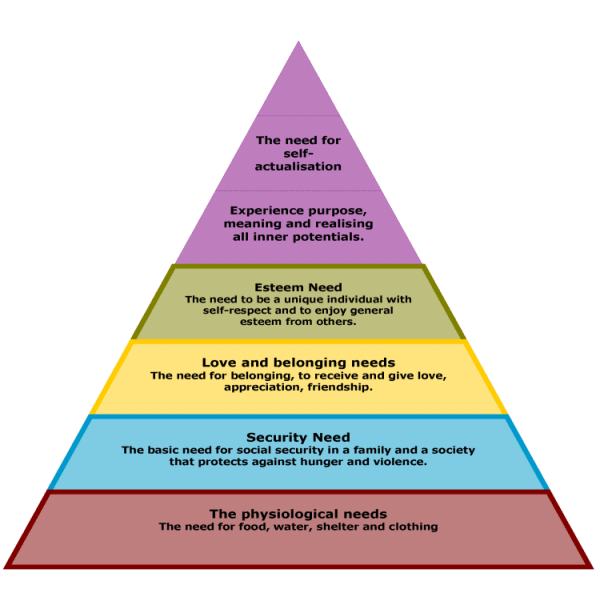
and as they get used to social stage they look at a higher level and move towards the Esteem stage
It could be a good insight for technology companies who are looking at innovate products or services to see that they enter with a purpose of serving the basic human need and then move higher up in the pyramid
On a lighter note, would as part of self actualization, people realize that there is nothing the technology can do, and hence walk away from technology? :)
Think about it
Cheers
Santosh