Well, after long delay and many missed deadlines mobile number portability (MNP) has come to effect. It is almost 2 months since MNP is in effect and there has been some traction in terms of people shifting from one service provider to another.
Some of the obvious impact of Mobile Number Portability are:
- The customer service and network offering would become better;
- Parity on the cost / packages
On other hand, I think there could be far more subtle impact on the current mobile marketing environment. 5 changes that i foresee are:-
- There could be increase in network locked phone schemes (Handset + Connection)...where-in high end phones are offered for lower prices
- Increased Value added services. Companies would offer access to exclusive content so as to keep the customer engaged with content and thus create higher exit barrier
- Annual subscription packages, in form of widgets and data which would get discontinued when people shift the service provider
- Common denominators across all service provider - including 3rd party maintained cellular towers, out sourcing of non core operations, etc (in fact it is already happening)
- Increased 'guerrilla marketing' .... while the bigger player would be looking at expanding the market, the smaller players would try to entice the existing customers of bigger player
Cheers
Santosh
Tampilkan postingan dengan label Mobile Marketing. Tampilkan semua postingan
Tampilkan postingan dengan label Mobile Marketing. Tampilkan semua postingan
Selasa, 29 Maret 2011

Impact of Mobile Number Portability in India
Well, after long delay and many missed deadlines mobile number portability (MNP) has come to effect. It is almost 2 months since MNP is in effect and there has been some traction in terms of people shifting from one service provider to another.
Some of the obvious impact of Mobile Number Portability are:
- The customer service and network offering would become better;
- Parity on the cost / packages
On other hand, I think there could be far more subtle impact on the current mobile marketing environment. 5 changes that i foresee are:-
- There could be increase in network locked phone schemes (Handset + Connection)...where-in high end phones are offered for lower prices
- Increased Value added services. Companies would offer access to exclusive content so as to keep the customer engaged with content and thus create higher exit barrier
- Annual subscription packages, in form of widgets and data which would get discontinued when people shift the service provider
- Common denominators across all service provider - including 3rd party maintained cellular towers, out sourcing of non core operations, etc (in fact it is already happening)
- Increased 'guerrilla marketing' .... while the bigger player would be looking at expanding the market, the smaller players would try to entice the existing customers of bigger player
Cheers
Santosh
Minggu, 22 Agustus 2010
Who do they think I am?
I was mentioning in my earlier post that almost 80% of the SMS messages I receive are SPAM. Looking at the propositions they are offering me through SMS, I think this is what they think I am – their Target Customer.
One Marketer thinks I am a pot-bellied person, and have some interesting schemes on buying slim belts for 0% interest on EMI’s
According to another Marketer, I am a rich person who invests in properties. The number of Apartments for sale, realty projects that is coming up in Delhi and NCR I have the details of those in my SMS inbox. Another Marketer too thinks the same way bombarding me with 12% return of Investment through mutual funds. How I wish I fell in this category
Yes, I am deeply into religion and devotion. With the service provider themselves sending me ‘exciting and interesting’ offers of VAS. Download a devotional song as ringtone or set it as a caller tune….else offers of Mobile wallpapers and screensavers of gods and goddesses is a daily norm
Some other marketer thinks otherwise about me. He believes I’d love to have photos of the top models in bikinis and swimsuits in my mobile phone
Also I’m a person who likes to indulge in a weekly sauna bath and visit SPA regularly.
Not to forget…they think that like most Indians I’m also crazy about Cricket…and would love to get any promo messages on Cricket/ cricketers
It is a known fact that for any database marketing, segmentation is very important. It is unfortunate that while the medium offers pin-point targeting, most marketers use the medium for carpet bombing. While me as a customer remains the same individual… each marketer think different about me, like the Elephant in the room... to each his own (version of me)
In the meantime can someone answer me - who am I really?
Santosh
Rabu, 02 Juni 2010
Technology – Building Bridges or Building Walls?
This can be part – 2 of my earlier blog on how technology affects human behaviour. Couple of things that has come to my notice in the past few days made me think… is the popular technology more of a communication enabler or disabler?
A colleague of mine has recently been to Singapore for holidays. An interesting observation, he mentioned, was that how people seem to be in their own world – the ear phones plugged, listening to their ipods, mobile phones, etc… or they were busy fidgeting with their mobile phones, either playing games or watching some video on the phone/ipod. They seem to be in their own world as if they have created an invisible wall around them.
Another is a report that was mentioning about the increase of mobile VAS. Currently the mobile VAS contributes to 12% (in India) of the revenue. While text (SMS) seems to be the major revenue generator in VAS services, contribution from other VAS sources like – Music downloads, Ringtones, Caller Ring Back Tone (CRBT), screensavers, etc are increasing at a fast pace.
You’ll see from the Internet access report image that except for checking emails…the rest of the activity are some form of self consumption
A quick look at how the Internet had trended over the past few years:
- Emailing, Chat rooms, were a big thing about a decade back. It seemed that Internet was being used a big way to ‘communicate’ with others. But stats now show that there is a decline in the usage of email… it has got replaced by search, which is more a personal activity and is all about self consumption. And chat rooms are being dismantled.
- In fact, even when Web 2.0 entered the scene…. Everyone said “here is a platform/tools by which people can converse, collaborate and share”. Tools like Facebook, MySpace, and Twitter all had taken the fancy of Internet users. While these platforms are being used for ‘communicating’ with others…. Slowly but surely these platforms are being transformed from ‘communicating’ platforms to platforms of self expression. How many of us now-a-days poke a friend?? How many put a wall posting on a friends profile asking them a basic social greeting like – How are you? Have a Nice day, etc…. I don’t do it.. and I’m sure neither would many of us be doing it.
- Also, have you noticed that most of the tweets or Facebook Updates are more about general things in life (and nothing about personal life updates).. people update about Weather, update about the current global/local news, links to articles, etc… very rarely are the updates talking about what is happening in ‘our’ lives or asking people what is happening in ‘their’ lives… These platforms are soon becoming stages for self expression, and broadcasting . Our personal live glimpses are best left inside of us
Why is it that technology starts of with the intent of filling a basic human need to being in touch with others and communicating with others … it on its way, changes track to fulfill a more self-centric need of humans – about self consumption or self-expression?
Could it be that the low entry barrier for any new technology to get adopted by the people is the Social Need stage as proposed by Maslow in the hierarchy of needs

and as they get used to social stage they look at a higher level and move towards the Esteem stage
It could be a good insight for technology companies who are looking at innovate products or services to see that they enter with a purpose of serving the basic human need and then move higher up in the pyramid
On a lighter note, would as part of self actualization, people realize that there is nothing the technology can do, and hence walk away from technology? :)
Think about it
Cheers
Santosh
A colleague of mine has recently been to Singapore for holidays. An interesting observation, he mentioned, was that how people seem to be in their own world – the ear phones plugged, listening to their ipods, mobile phones, etc… or they were busy fidgeting with their mobile phones, either playing games or watching some video on the phone/ipod. They seem to be in their own world as if they have created an invisible wall around them.
Another is a report that was mentioning about the increase of mobile VAS. Currently the mobile VAS contributes to 12% (in India) of the revenue. While text (SMS) seems to be the major revenue generator in VAS services, contribution from other VAS sources like – Music downloads, Ringtones, Caller Ring Back Tone (CRBT), screensavers, etc are increasing at a fast pace.
You’ll see from the Internet access report image that except for checking emails…the rest of the activity are some form of self consumption
A quick look at how the Internet had trended over the past few years:
- Emailing, Chat rooms, were a big thing about a decade back. It seemed that Internet was being used a big way to ‘communicate’ with others. But stats now show that there is a decline in the usage of email… it has got replaced by search, which is more a personal activity and is all about self consumption. And chat rooms are being dismantled.
- In fact, even when Web 2.0 entered the scene…. Everyone said “here is a platform/tools by which people can converse, collaborate and share”. Tools like Facebook, MySpace, and Twitter all had taken the fancy of Internet users. While these platforms are being used for ‘communicating’ with others…. Slowly but surely these platforms are being transformed from ‘communicating’ platforms to platforms of self expression. How many of us now-a-days poke a friend?? How many put a wall posting on a friends profile asking them a basic social greeting like – How are you? Have a Nice day, etc…. I don’t do it.. and I’m sure neither would many of us be doing it.
- Also, have you noticed that most of the tweets or Facebook Updates are more about general things in life (and nothing about personal life updates).. people update about Weather, update about the current global/local news, links to articles, etc… very rarely are the updates talking about what is happening in ‘our’ lives or asking people what is happening in ‘their’ lives… These platforms are soon becoming stages for self expression, and broadcasting . Our personal live glimpses are best left inside of us
Why is it that technology starts of with the intent of filling a basic human need to being in touch with others and communicating with others … it on its way, changes track to fulfill a more self-centric need of humans – about self consumption or self-expression?
Could it be that the low entry barrier for any new technology to get adopted by the people is the Social Need stage as proposed by Maslow in the hierarchy of needs
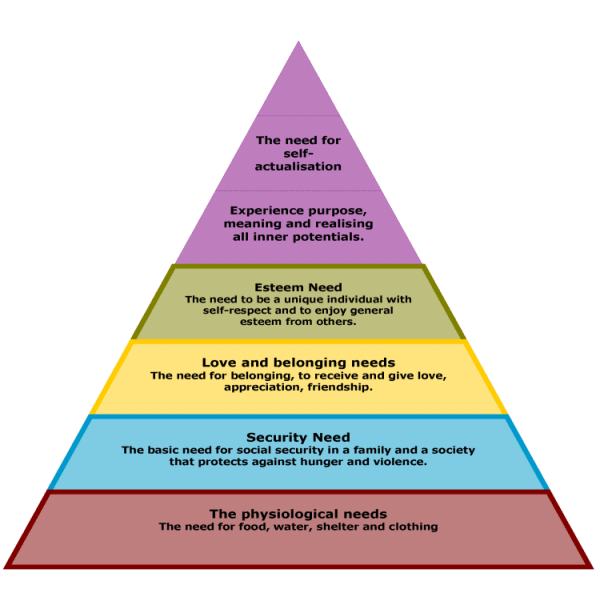
and as they get used to social stage they look at a higher level and move towards the Esteem stage
It could be a good insight for technology companies who are looking at innovate products or services to see that they enter with a purpose of serving the basic human need and then move higher up in the pyramid
On a lighter note, would as part of self actualization, people realize that there is nothing the technology can do, and hence walk away from technology? :)
Think about it
Cheers
Santosh
Technology – Building Bridges or Building Walls?
This can be part – 2 of my earlier blog on how technology affects human behaviour. Couple of things that has come to my notice in the past few days made me think… is the popular technology more of a communication enabler or disabler?
A colleague of mine has recently been to Singapore for holidays. An interesting observation, he mentioned, was that how people seem to be in their own world – the ear phones plugged, listening to their ipods, mobile phones, etc… or they were busy fidgeting with their mobile phones, either playing games or watching some video on the phone/ipod. They seem to be in their own world as if they have created an invisible wall around them.
Another is a report that was mentioning about the increase of mobile VAS. Currently the mobile VAS contributes to 12% (in India) of the revenue. While text (SMS) seems to be the major revenue generator in VAS services, contribution from other VAS sources like – Music downloads, Ringtones, Caller Ring Back Tone (CRBT), screensavers, etc are increasing at a fast pace.
You’ll see from the Internet access report image that except for checking emails…the rest of the activity are some form of self consumption
A quick look at how the Internet had trended over the past few years:
- Emailing, Chat rooms, were a big thing about a decade back. It seemed that Internet was being used a big way to ‘communicate’ with others. But stats now show that there is a decline in the usage of email… it has got replaced by search, which is more a personal activity and is all about self consumption. And chat rooms are being dismantled.
- In fact, even when Web 2.0 entered the scene…. Everyone said “here is a platform/tools by which people can converse, collaborate and share”. Tools like Facebook, MySpace, and Twitter all had taken the fancy of Internet users. While these platforms are being used for ‘communicating’ with others…. Slowly but surely these platforms are being transformed from ‘communicating’ platforms to platforms of self expression. How many of us now-a-days poke a friend?? How many put a wall posting on a friends profile asking them a basic social greeting like – How are you? Have a Nice day, etc…. I don’t do it.. and I’m sure neither would many of us be doing it.
- Also, have you noticed that most of the tweets or Facebook Updates are more about general things in life (and nothing about personal life updates).. people update about Weather, update about the current global/local news, links to articles, etc… very rarely are the updates talking about what is happening in ‘our’ lives or asking people what is happening in ‘their’ lives… These platforms are soon becoming stages for self expression, and broadcasting . Our personal live glimpses are best left inside of us
Why is it that technology starts of with the intent of filling a basic human need to being in touch with others and communicating with others … it on its way, changes track to fulfill a more self-centric need of humans – about self consumption or self-expression?
Could it be that the low entry barrier for any new technology to get adopted by the people is the Social Need stage as proposed by Maslow in the hierarchy of needs
and as they get used to social stage they look at a higher level and move towards the Esteem stage
It could be a good insight for technology companies who are looking at innovate products or services to see that they enter with a purpose of serving the basic human need and then move higher up in the pyramid
On a lighter note, would as part of self actualization, people realize that there is nothing the technology can do, and hence walk away from technology? :)
Think about it
Cheers
Santosh
Rabu, 21 Januari 2009
3G & BWA: The Next Frontier, A report FICCI and BDA released a joint report on 3G & BWA yesterday at FICCI, New Delhi.
The objective of this Report is to provide an operational, on-the-ground perspective of the future of 3G and BWA services in India, and is based on extensive industry inputs from carriers, handset OEMs, network OEMs,VAS providers and policy makers.
The Highlights of the report include:
* 89.9mn 3G Subscribers (including 67.5mn handsets and 22.4 modem subscribers) by 2013
* 3G subscriber base will represent 12% of the overall wireless subscriber base contributing USD 15.8bn in service revenues in 2013.
* Annual 3G device sales are estimated to reach 81.3mn in 2013, with replacement market contributing to 52% of device sales in that year.
* 3G ARPU is projected to reach USD 18.3 by 2013 with revenues totaling USD 12.8bn in the same year. Data is expected to contribute 29% to 3G ARPU from handet users.
* The overall broadband subscriber base (including wireline,3G modem and BWA) is projected to grow to 46.1mn users by 2013 with an overall PC installed base of 75mn. Total 3G modem subscribers are expected to reach 22.4mn by 2013 with sales of 13.6mn new modems.
* WiMAX will emerge as a strong competitor for providing residential and enterprise BWA connectivity in un-served and under-served areas.Industry inputs suggest use of IEEE 802.16e standard, even for fixed applications due to lower CPE costs than 802.16d and a larger vendor ecosystem.
* The report projects a subscriber base of 10.8mn WiMAX users by 2013, growing at a CAGR of 80% from 2009.
The entire report can be downloaded here.
3G to be launched in Delhi in 10 days
State-run Mahanagar Telephone Nigam Ltd (MTNL) has said that it plans to launch 3G telecom services in national capital New Delhi in next 10
days. MTNL plans to launch 3G services in the commercial capital Mumbai by first week of February, reports PTI (via Business Standard). MTNL has not tied up with any content providers and has said that its Internet Protocol Television (IPTV) providers would give it the content.
Department of Telecom issued Bharat Sanchar Nigam Ltd (BSNL) and MTNL spectrum to roll out all-India 3G services last year. The spectrum
auction for private telecom companies has been continually delayed, and many foreign companies may stay away due to global economic slowdown.
Click here to view this article
Cheers
Santosh
Senin, 10 November 2008
General Elections in India - Canvassing Digital Style
The US Elections and the results have been historic. The way the campaign was fought and the results there of, are the cocksure way of the way the wind blows. Much more the results (it was a foregone conclusion that the anti-incumbency votes would prevail in this election), I was keener on the way the election was fought.
The use of Online and digital media in the US election was awesome. It will be talked about and replicated in the developed world and maybe in countries like India too.
India is going in for its General Elections in early 2009. In the meantime there are lot of states that would be going to elections. The elections in Delhi are slated for end of November. Already candidates sending emails to residents of specific locality has come in news articles.
India has substantial online users (close to 35 Million) and a large population who have mobile phones (over 300 Million in the last count). Reaching out to this audience would be of paramount importance to all parties.
From an advertising point of view digital is a cost effective and an efficient medium. The best part of digital medium is that of optimizing the campaign in between and also the targeting and customization that is possible.
The social networking sites talks about millions of registered users.. and sites likes Orkut claims to have 8 Million profiles from India... Not a bad place to canvass, eh. Imagine targeted banners, where in you can put the local candidate’s photo on the banner ads...
A study by researchers from Princeton and Michigan Universities, together with the US Student Public Interest Research Group (PIRG) New Voter Project Mobile Voter and Working Assets found that text message reminders to new voters increased an individual’s likelihood of voting by close to 5 percentage points. This is an increase similar to ‘quality phone call’ reminders, but at a fraction of the cost.
Where does this leave the Indian politician, and what he/she can do to reach out in this networked digital world? Discounting the fact, that most candidates are of the dinosaur era, and their internet and mobile awareness might be no different from an trained orangutan:). Here are some digital tactics they can adopt for this elections..
Online
Campaign Website
Candidate profile on popular SNS - Orkut/Facebook
Emailer activity
Banner ad campaigns - targeted
Online Webcasts
Online give-away collaterals like Ringtone, wallpaper, downloads, etc
Mobile:
SMS
Shortcode
IVRS
MMS
WAP access
Campaign Website:
Each party should have a specific campaign website. The website should highlight what their manifesto is, list of their candidates, A video clip from their leader, Discussion board, The leader schedules, the problems that they will address - national and local (interactive map format).. Polling booth details, etc, etc
SNS sites:
All the candidates needs to have their profile pages on popular SNS sites,, with their complete bio, what their contribution to the society was, is and will be. People can post scraps and the campaign managers’ needs to respond to those at the earliest. Photos, party symbols, ad collaterals can all be linked to for downloads. RSS feeds for alerts from the candidates needs to be provided.
Email Activity:
Regular email activity (once a month/fortnight, based on timelines) can be sent to selected database in each candidate’s constituency. The mails will be from the candidate and personal in nature. I read somewhere, that a candidate from one of the constituency in Delhi is doing this activity.
Banner ads:
The party can go for a pan-India banner campaign that will be targeted banner ads. The banner ads are customized based on the candidate, and the message talking about the local issue pertaining to that state/constituency
Webcast & Online take away collaterals:
These can be part of the campaign website - where in the user can download various branded collaterals, and also watch webcasts of the candidates or the party leaders in action.
The party can also look at online mock campaigns to see what the user reactions are - this would be done independent of the campaign websites. This would give the campaign managers a dipstick into pulse of the public and can optimize/change their campaign tactics
Internet through its shallow penetration may not be as effective as the other forms of traditional mass media. But, the truth of the matter is most of the 'influencers' - the intelligentsia, the media people are all Internet Savvy. They look at information on the net, which is reproduced and picked up in the traditional mass media formats. Hence it is imperative that the parties give a serious thought and have Internet as part of their marketing strategy.
India has the second largest mobile population. Close to 27% of India population are mobile phone users. This medium can be really effective in the coming general elections.
SMS: One of the best and simplest forms of sending the message across would be through the SMS. It is cheap and it is targeted. The message can be localised give the candidate name, the party symbol, and the date of election, etc. The fact that the service providers and handsets now have an option of sending vernacular messages helps
Shortcode: The power of shortcode is that it can be part of all the marketing collaterals; and people have an effective way of being in touch with the party/candidates. The shortcode can also be used for pull message - giving all the information which the general public is seeking for..
IVRS: We, culturally, are a society, wherein sound holds an important part. Us ne vachhan diya, mard ki zuban, etc are of paramount importance in our society. Hearing/listening to someone is more comfortable than words... and IVRS - with recorded messages can play an important part in the canvassing.
MMS: Sending MMS clips to people can also be effective, when canvassing through the mobile space..A 2 minute clip which is 'viral' in nature can be really effective in creating WOM (Word of Mobile)
WAP Access: 25 Million people accessed information through their mobile phones last year. And a WAP site would go a long way in terms of communicating more than 160 characters or 2 minute sound/video clips.
I am sure - this elections will be fought in villages, street corners, public grounds, print, TV, radio, and of course the cyberspace.
Cheers
Santosh
Langganan:
Postingan (Atom)